Nest, the Maker of a "learning thermostat" that controls the temperature at home while adapting to citizenry's habits and preferences, has recently been courting developers of other smart consumer devices and then that its bring up company, Google, can become the gateway to the forceful world besides as to the Cyberspace.
Already, Nest devices can integrate with "smart" LIFX promiscuous bulbs, Mercedes-Benzes, Whirlpool washing machines, and Jawbone wearable activity trackers. Through its Thoughtful Things Investment trust (non fashioning that call dormy), Google's risk capital group is even offering financial support to entrepreneurs to assistant "bring their sentient habitation ideas to sprightliness."
It's not perfect how very much people are really demanding, enounce, a service department door that communicates with their thermostat. But Nest's latest partnership with the company Adult Ass Fans (as wel not making that name up) is a Thomas More newsworthy nonpareil for homeowners, because the integration could save much on your summer air conditioning bill.
By circulating gentle wind, level the lowest-tech ceiling fans can cool a room and allow you to turn down the AC. Just most people are lazy and don't bother to ferment on their fans, or if they do, they function a fan only when non using an air conditioner. But a fan and an air conditioning that talked to one another and both automatically adjust to your temperature preferences? Now there's the potency to run for the thermostat at a high temperature, compensated away the chilling upshot of the fan.
That's the idea tooshie the partnership announced today between Nest and Big Ass Fans, a 15-twelvemonth-old company based in Lexington, Kentucky.
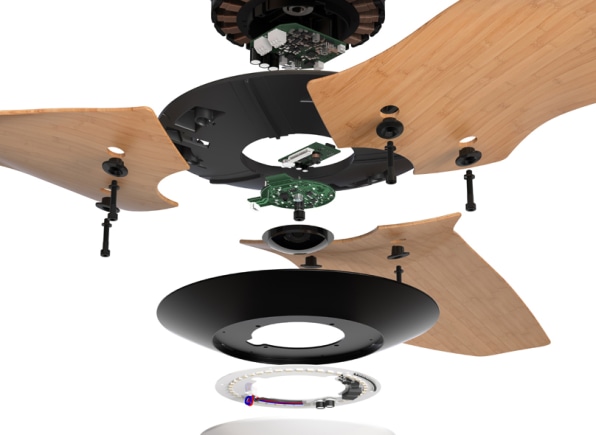
Hulking Ass Fans started life as the HVLS Fan Company, but as traditional knowledge has information technology, later changed its name when customers would much comment along its, indeed, big ass fans, which were originally premeditated to efficiently cool large industrial spaces where send conditioning was not practicable. (They come as large as 24-feet in diam.) With aerodynamic line foils and ultra-quiet, efficient motors that were developed by an in-house engineer, its grocery soon expanded to churches, schools, and last homes, with the creation of a notably smaller model.
The Haiku, A the human activity production is called, uses only two to 30 watts of power depending on the stop number–less than an light light bulb. Chief executive officer Carey Smith claims Haiku is the most efficient cap lover in the world, and information technology has the EnergyStar ratings to prove it. "If all cap fan in the country utilized the technology, it would be like we would eliminate Connecticut from the grid," he says.
In June, the company announced a new Haiku "smart" simulate, with enclosed sensors and a CPU that turns the fan off and on automatically when a person enters or leaves the board. Equal the Nest, it as wel adjusts the winnow's speed depending on the way's current climate and preferences IT learns over time from the user. Smith says the Haiku would admit residents to raise their thermoregulator setpoints by vi degrees and save 30% happening air conditioning costs at the same level of comfortableness. For the average place, this translates to annual nest egg of almost 600 kilowatt hours operating theater $78 settled connected current electricity rates, and much than 800 pounds of carbon dioxide.
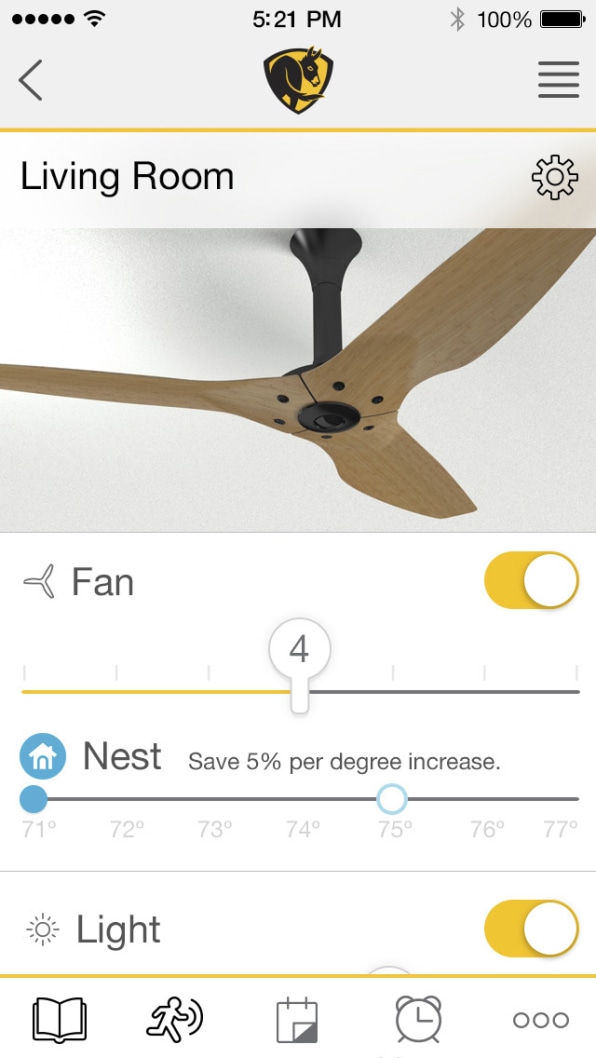
The problem is that to get these benefits, a person has to manually adjust the thermostat. With the Nest integration via a smartphone app, the fan and AC can work together in concert without any input from a human.
The company thinks there's a large potential market, given that there are 300 million ceiling fans in the U.S.–an average of trio to cardinal per place. Haiku fans without any smart technology have been on the market for several years and nearly 60,000 cause been sold-out so far. "Everyone negotiation more or less the smart home and home mechanization, only 90% of that stuff is just a fancy remote master–IT still requires a button on a smartphone," says David Sir Joseph Banks, Big Prat motor and controls engineering manager. "People just neediness something that'll make their spirit simpler."
As for the data solicitation aspect, Smith doesn't think the data it leave adopt from people's fan usage will be of some value to Big Ass Fans itself, since it's already spent so much meter doing beta examination and user inquiry. (For the hoi polloi who connect it to Nest, Google will set about that data likewise).
The Haiku with SenseME technology, as the smart fan model is called, will get merchant marine this summertime. For Nest owners, it will be intelligent to connect with a smartphone app.
How to Remove Stuck Fan Blades Ac Fan Motor
Source: https://www.fastcompany.com/3034357/this-smart-ceiling-fan-links-with-nest-to-make-your-ac-more-cool-while-using-less-energy


0 Komentar
إرسال تعليق